
Most specification mistakes on manhole covers are load class mistakes. Either the project paid for a class it will never load, or a B125 ended up where trucks turn.
Both come from the same place. The letter and number stamped on a cover get read as a product grade, when they describe a job. This guide explains what each class is for, how to choose one, and where the choice goes wrong.
What the class actually is
EN 124 sorts covers and gratings into six classes by where they are installed. Each class carries a test load, applied through a steel block onto the cover while it sits in its own frame.
That has two consequences worth stating plainly.
A class is a test load, not a vehicle weight. D400 does not mean “a 40-tonne truck is the limit”. It means the cover has to pass a 400 kN test, which is roughly 40 tonnes of force on the block. Real wheel loads, impact and repetition are different things, and the class is a standardised threshold rather than a prediction.
A class is also a statement about location. The standard describes each one by where it is used, which is why the first question is never “how strong?” It is “where does this sit?”
The six classes at a glance
| Class | Test load | Where it is used |
|---|---|---|
| A15 | 15 kN, about 1.5 t | Areas used only by pedestrians and cyclists |
| B125 | 125 kN, about 12.5 t | Footways, pedestrian areas, car parks and parking decks |
| C250 | 250 kN, about 25 t | Kerbside channel zone, a short distance into the carriageway |
| D400 | 400 kN, about 40 t | Carriageways of roads, hard shoulders, parking areas for all road vehicles |
| E600 | 600 kN, about 60 t | Areas with high wheel loads, such as docks |
| F900 | 900 kN, about 90 t | Areas with particularly high wheel loads, such as aircraft pavements |
For most UAE work the real decision sits between B125, C250 and D400. A15 is rare on any project with a vehicle on it, and E600 and F900 belong to ports and airfields.
Choosing the class: three questions
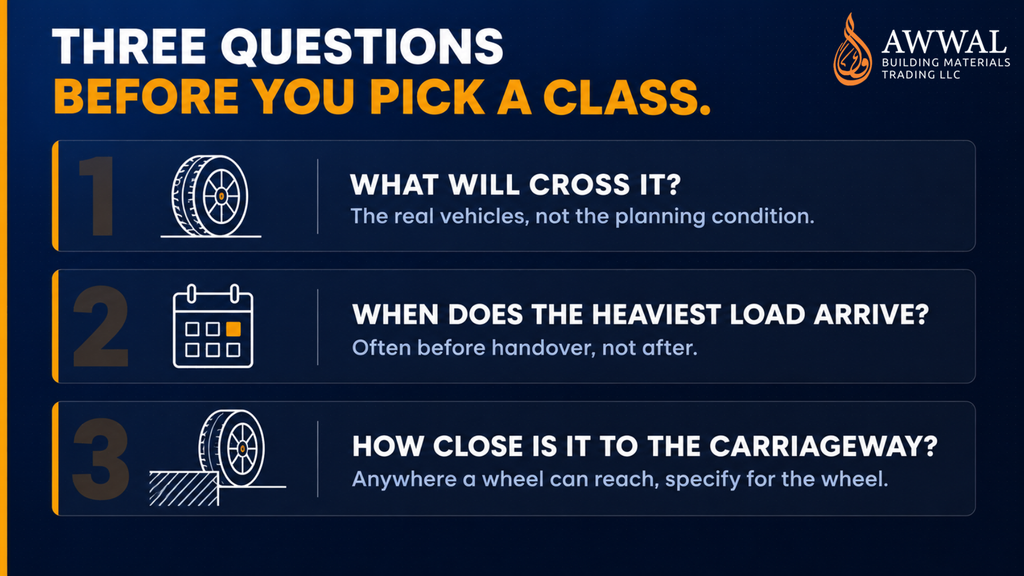
What will actually cross this cover? Not the planning condition and not the design intent. The vehicles that will really use this location. A residential road officially closed to heavy vehicles still gets the occasional removal truck and, during construction, the concrete mixer.
When does the heaviest load arrive? Often before handover. Fit-out deliveries, mixers and cranes cross covers that were specified for a finished car park or plaza. The class is set by the heaviest wheel that will ever cross the cover, and that includes the ones that cross it before anyone moves in. If the construction traffic is heavier than the finished use, either specify to the construction load or protect the cover until the heavy work is done.
How close is it to the carriageway? A cover at a kerb edge or a car park entrance is not in the same position as one in the middle of a bay. Anywhere a wheel can reach, specify for the wheel.
Class by location on a UAE project
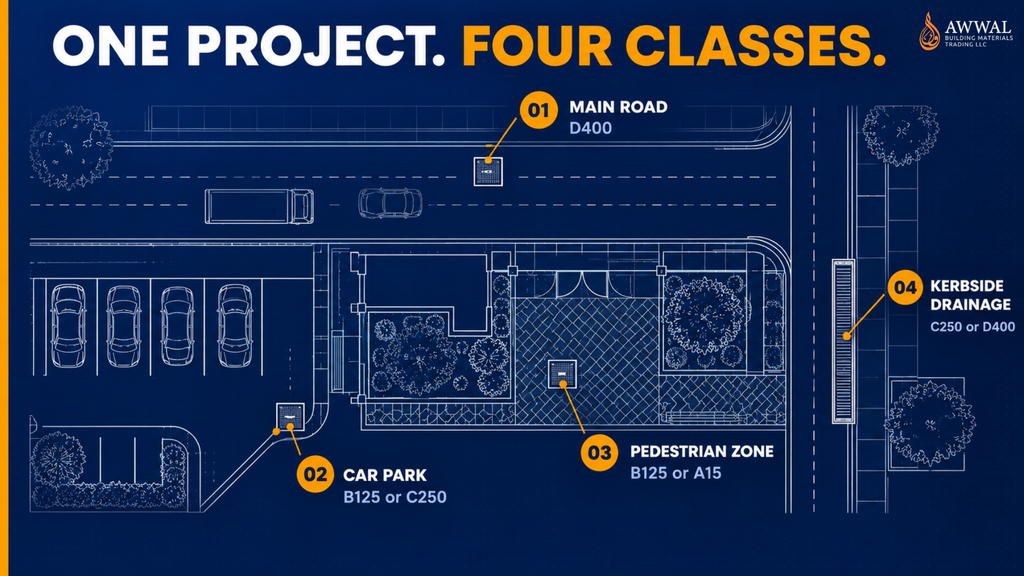
Main roads and carriageways: D400. Any road a truck can legally use is a D400 road. This covers arterials, collector roads and commercial access routes, and it is the default for most UAE carriageways.
Residential estate roads: C250 at minimum, D400 where deliveries or utilities use the road. B125 is for footways and car parks, not for a road that cars, vans and occasional trucks all use.
Car parks and service areas: B125 or C250. The deciding factor is whether delivery vehicles enter. A podium car park with barrier control sits differently from a retail car park where trucks arrive. Where there is doubt, take the higher class.
Pedestrian plazas and streetscapes: B125 or A15. These are the lowest classes in common use. Check for maintenance vehicles and for the construction route before settling on the lightest class available.
Kerbside drainage channels and gratings: C250 or D400. C250 suits the channel zone itself. Where trucks mount the kerb, or the grating is at the carriageway edge, D400 is the safer specification.
Ports, docks and heavy yards: E600 or F900. Specify these only where the operator confirms the wheel loads.
The two mistakes
Under-specifying is the expensive one. A B125 cover in a location that sees trucks looks fine on delivery day. It starts rocking months later, the frame loosens and water finds the gap. By then it presents as a product failure and the real cause is a specification decision made at the tender.
Over-specifying wastes money quietly. A D400 cover in a pedestrian courtyard is not unsafe, it is just paid for and never used. Rarely a problem, rarely worth doing across a whole project.
Rule of thumb: when unsure, go up one class. The cost of an extra class is small and visible at order stage. The cost of a missing one is large and shows up on a live road.
The frame carries the class too
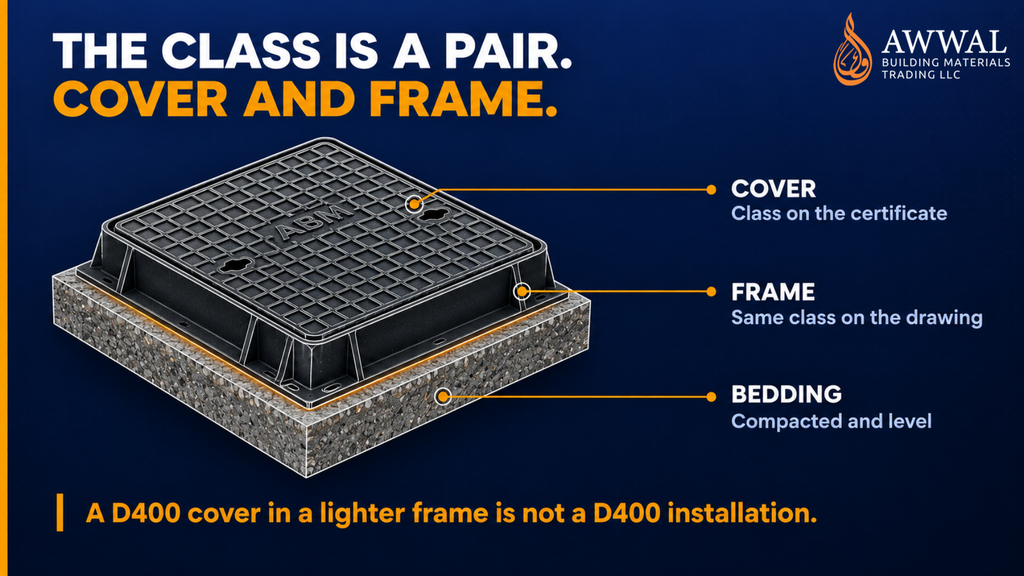
A cover is only half of an installation. The class depends on the cover and the frame it sits in. A D400 cover in a lighter frame is not a D400 installation.
Check the frame class against the cover class on the dimensional drawing, and check that the frame is set level to the finished surface and bedded properly. Many rocking covers on UAE roads are frame and bedding problems with a correctly rated cover on top.
What to ask for before ordering
Three documents settle a class question, and none of them is a brochure.
The EN 124 test certificate for the specific product at the specific class, issued by an accredited body. A reference to the standard on a datasheet is not a certificate.
The material test report for the batch, confirming grade and composition.
The dimensional drawings, confirming frame class, seating and clear opening.
Ask for all three before the order goes in. A supplier who can produce them quickly is telling you something, and so is one who says they are on the way.
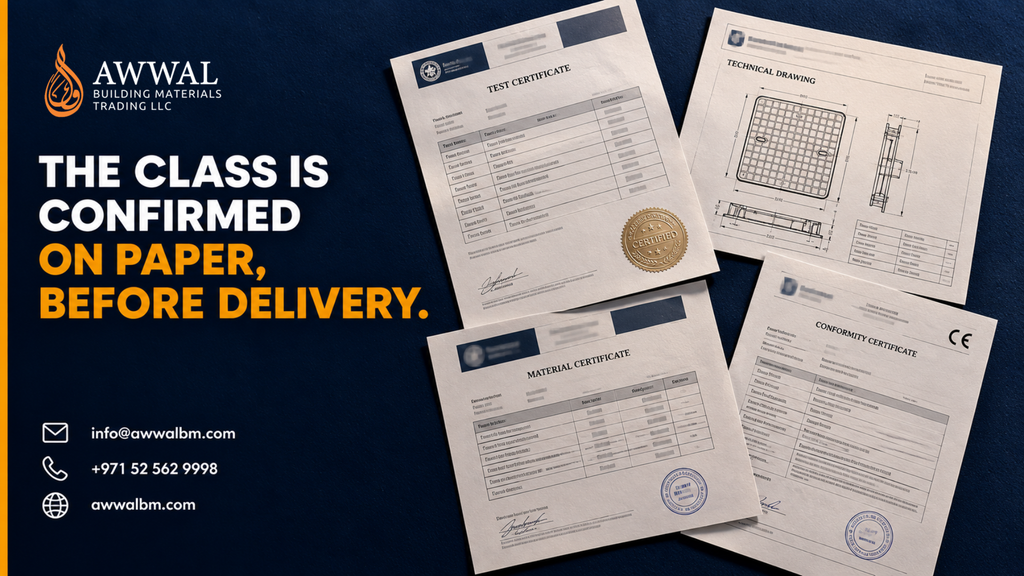
At Awwal Building Materials, the EN 124 certificate, the ISO 9001:2015 record, the material test report and the dimensional drawings are sent before the cover ships, not after, so the class is confirmed on paper before it reaches site.
Not sure which class your project needs? Send us the location and traffic type, including any construction traffic. Quote in 24 hours.
📩 [email protected]
📞 +971 52 562 9998
🌐 awwalbm.com