
One of the most common specification errors on UAE projects isn’t choosing the wrong brand. It’s choosing the right product for one location and ordering it for all of them.
A main carriageway and a residential estate road look similar on a procurement order. They are not the same engineering problem, and the cover that performs correctly on one will either be over-engineered on the other or fail prematurely because of it.
This guide maps the right product and load class to six common UAE application types. It is not exhaustive — every project has variables — but it covers the decisions that generate the most avoidable problems on UAE sites.
How load class works
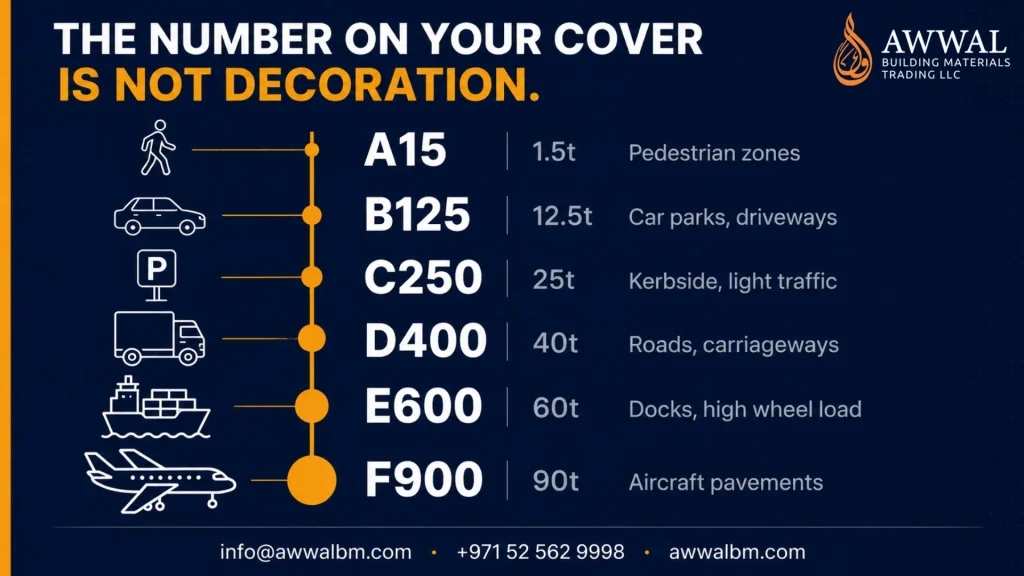
Before mapping applications, it is worth being clear about what the EN 124 load class actually specifies.
The class defines the maximum load the cover must withstand during a standardised test — applied through a steel block onto the cover while it sits in its own frame. A15 is rated to 1.5 tonnes, B125 to 12.5 tonnes, C250 to 25 tonnes, D400 to 40 tonnes, E600 to 60 tonnes and F900 to 90 tonnes.
The class is not a description of the maximum static load the cover will ever see. It is a performance threshold under dynamic test conditions. A cover specified at D400 is not guaranteed to survive anything below 40 tonnes and fail at 40 — it is guaranteed to meet the test criteria at that class. Real-world performance over 30 years depends on correct frame installation, correct bedding, and the right material for the environmental conditions.
Selecting a class that exceeds what the application needs is rarely a problem. Selecting one below it is always a problem — it just takes time to show up.
Main carriageways and arterial roads
Specification: Solid Top D400, Ductile Iron Gr 500/7
The default specification for any UAE road open to mixed traffic, including commercial vehicles, is D400. This covers the vast majority of roads in Abu Dhabi, Dubai, Sharjah, and the Northern Emirates — any road a truck can legally use is a D400 road.
The product is a Solid Top cover — sealed surface, no openings, load transferred cleanly to the frame. Ductile iron is the correct material rather than grey cast iron for two reasons. First, the elongation capacity — 7% minimum for Gr 500/7 versus under 1% for grey cast iron — means the cover flexes under dynamic load rather than accumulating micro-fractures. Second, the thermal cycling on an exposed UAE carriageway is significant. Surface temperatures exceed 60°C in summer and drop considerably overnight. Ductile iron handles that cycle better over a 30-year service life.
Size selection depends on the chamber below, but 600×600 is the most common for standard access chambers on UAE roads. The dimensional drawings should be confirmed against the frame before delivery.
Highways and high-speed roads
Specification: Solid Top D400 or E600, Ductile Iron, anti-noise seating
Higher speed traffic introduces a dynamic loading consideration that standard carriageway specification sometimes overlooks. A truck crossing a cover at 80 km/h applies load differently to one crossing at 30 km/h. The impulse loading is higher, and a cover that seats correctly under slow traffic can generate noise or movement under high-speed crossing.
For highway applications, the FIC Double Triangular is worth considering. The seating geometry reduces movement under dynamic load, which reduces both noise and the gradual loosening of the frame-to-cover contact that eventually causes rocking. E600 should be specified where heavy vehicle concentrations are high — docks access roads and logistics zone highways rather than standard arterials.
On highways specifically, frame installation tolerance is critical. A frame that is two millimetres proud of the road surface on a residential street is a minor maintenance issue. On a highway, the same proud frame generates significant impact loading on every vehicle crossing, and the cumulative effect accelerates failure on both the cover and the frame seat.
Residential estate roads
Specification: Solid Top B125 or C250, Ductile Iron or Cast Iron
Residential roads within gated communities and housing developments present a genuinely different loading profile. The traffic is predominantly private passenger vehicles, with occasional light commercial deliveries. Heavy trucks should not be accessing these roads, but the specification should account for the occasional removal truck, concrete mixer during construction, or municipality vehicle during maintenance.
B125 covers pedestrian and very light vehicle loads only — genuinely unsuitable for a road where any four-wheel vehicle crosses regularly. C250 is the correct minimum for a residential road where the surface is technically closed to trucks but practically receives occasional heavier vehicles.
Cast iron is a defensible material choice on lower-traffic residential roads where the dynamic load profile is genuinely light and consistent. The cost saving is real. The trade-off is a shorter service life and less tolerance for the occasional overload — a concrete mixer accessing a plot during construction can exceed a CI cover’s design load if the class was specified at the low end.
Car parks and service areas
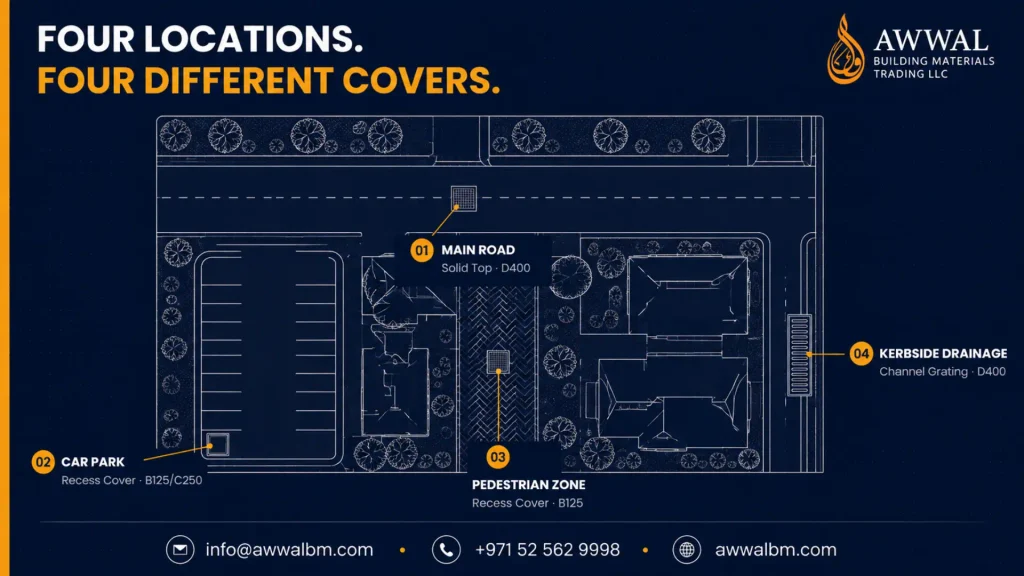
Specification: Recess Cover B125 to C250, or Solid Top C250
Car parks introduce two variables that residential road specification does not — finish quality and occasional delivery vehicle access.
Where the car park surface is a paving pattern and aesthetic continuity matters, a Recess Cover is the correct product. The tray design accepts the same paving material used across the rest of the surface, so the access point disappears rather than interrupting the pattern. The tray depth must be specified to match the paving thickness exactly — a mismatch of even a few millimetres results in a proud or recessed finished surface that creates a trip hazard and looks poorly installed.
Load class depends on whether delivery vehicles access the car park. A residential building podium car park with barrier control: B125 is defensible. A retail car park or logistics facility parking area where delivery trucks enter: C250 minimum, D400 if significant vehicle weights are expected.
For car parks where finish is less critical and concrete or asphalt is the surface material, a Solid Top C250 is simpler and slightly cheaper. The additional complexity of the recess system is only worth it where the surface aesthetic justifies it.
Pedestrian zones and streetscapes
Specification: Recess Cover B125, or Solid Top B125, Ductile Iron
Purely pedestrian areas — plazas, waterfront promenades, park paths — have the lowest load class requirement. B125 is the correct class where the area is genuinely restricted to pedestrians and at most light maintenance vehicles.
The more important specification decision in pedestrian zones is finish, not load class. A Recess Cover with tiles matched to the surrounding surface pattern is the standard in UAE public realm projects, and the installation quality matters considerably more here than in a road application. In a plaza setting the cover is visible at eye level, at close range, in a context where people are walking slowly and noticing the environment around them. A poorly fitted recess cover with a mismatched tile or a frame sitting out of level is visible in a way it simply isn’t in a road.
The tray depth specification for pedestrian paving is also more complex than for road applications. UAE pedestrian zones frequently use large format tiles at varying depths — 20mm, 30mm, 40mm — and the recess cover tray depth must be selected to match the specific tile being used, not a standard depth. This is worth confirming with the paving contractor before the cover order is placed.
Drainage channels and surface water management
Specification: Channel Gratings C250 to D400, Ductile Iron
Drainage is a separate product category from access covers, but it appears in the same procurement process and the specification logic is similar. Channel Gratings handle surface water — they sit at kerb level and move water from the road surface into the drainage system below.
UAE rainfall is infrequent but arrives in high intensity. A drainage channel that flows freely under normal conditions can back up rapidly during a storm event if the grating is undersized for the flow or if the open area has been reduced by debris accumulation. The grating size should be selected for peak flow capacity, not average.
Load class for channel gratings follows the same logic as covers. D400 for any grating in or adjacent to a trafficked carriageway. C250 for kerbside locations with occasional vehicle overhang. The most common error is specifying C250 for a location that receives truck wheel loads at the kerb edge — a truck stopping with its front wheel on a C250 grating is applying close to the rated load in a dynamic situation.
Slot width matters for debris management. Wider slots drain more freely but allow larger debris to enter. UAE environments with significant sand and construction dust tend to accumulate faster in narrower slots, so maintenance frequency should factor into the selection.
The specification checklist before any order
Regardless of application, three things should be confirmed before any cover or grating order is placed on a UAE project.
Load class confirmed against actual traffic. Not the design intent traffic, not the planning condition — the actual vehicles that will cross this location during construction, during the project’s operational life, and during maintenance. These are rarely the same number.
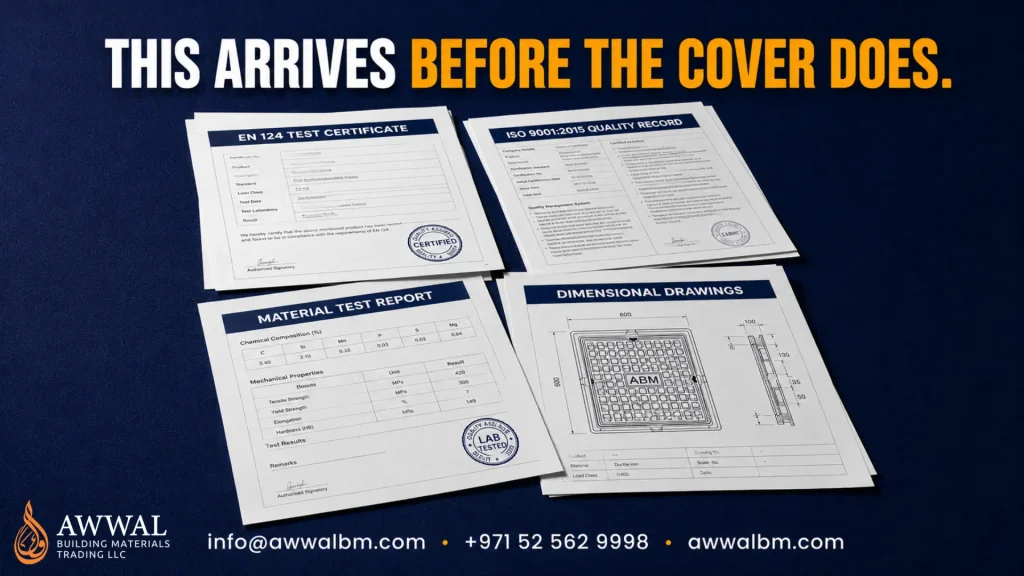
EN 124 test certificate on file for the specific product and class. Not a reference to the standard in a datasheet, not a brochure claim — the certificate from an accredited testing body for the product being ordered.
Dimensional drawings confirmed against the frame. A cover that meets the load class but sits loosely in its frame has a tolerance gap from day one. The EN 124 certificate and the dimensional drawing are separate documents that together confirm fit, not just load capacity.
At Awwal Building Materials, all three are supplied as standard with every order — before delivery, not on request after it.
Not sure which specification your UAE project needs? Send us the application details and we’ll confirm the right product and load class within 24 hours.
📩 [email protected]
📞 +971 52 562 9998
🌐 awwalbm.com