
Most problems with manhole covers on UAE projects do not start on site.
They start weeks earlier — when someone fills in a specification without thinking too carefully about what they actually need.
The cover arrives. It goes in. Then six months later it starts rocking, cracking, or failing inspection. And by that point the project has been handed over, the contractor has moved on, and someone is stuck with a repair bill that is far bigger than the price difference between getting it right and getting it wrong.
This guide walks you through the four things you need to get right when specifying manhole covers for any UAE project — whether you are a consultant drawing up a tender, a contractor procuring for site, or a procurement manager reviewing a supplier’s submittal.
Why Getting the Specification Right Matters
A manhole cover is not a complicated product. But it sits at the intersection of several things that matter enormously on a UAE project — load bearing capacity, compliance documentation, material performance in extreme conditions, and long-term durability.
Get all four right and the cover performs without incident for 25 to 30 years. Get one wrong and you are dealing with a failed inspection, an angry client, or an emergency replacement on a live road.
The good news is that specifying correctly takes no more time than specifying badly. You just need to know what to ask for.
Step 1 — Match the Load Class to the Actual Traffic
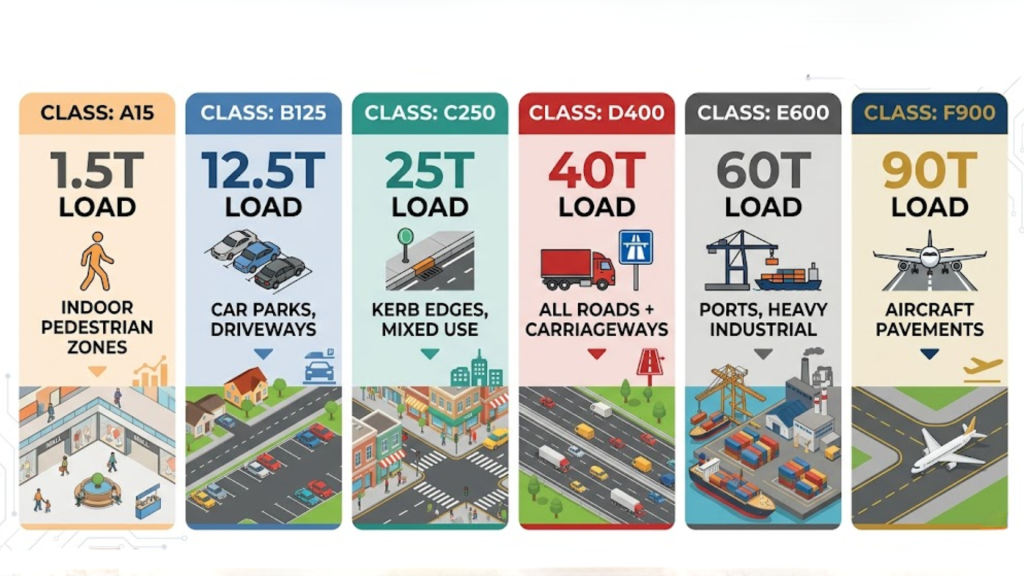
Every manhole cover is rated for a maximum load. That rating is expressed in kilonewtons (kN) under the EN 124 standard, and it tells you exactly how much force the cover can take before it fails.
The six classes are:
A15 — 1.5 tonnes For pedestrian-only areas with no vehicle access at all. Indoor zones, private courtyards, hotel lobbies.
B125 — 12.5 tonnes For car parks and residential driveways with light vehicle traffic. Passenger cars only — not trucks.
C250 — 25 tonnes For kerb-edge positions and mixed-use car parks where light commercial vehicles might cross.
D400 — 40 tonnes The most common class on UAE projects. Any road open to trucks needs D400 as a minimum. Main roads, estate roads, carriageways, hard shoulders — D400.
E600 — 60 tonnes For ports, logistics zones, and heavy industrial areas where vehicles exceed normal road weight limits.
F900 — 90 tonnes For aircraft pavements. Dubai International Airport, Abu Dhabi Airport, military airstrips.
The mistake people make most often is specifying B125 for a location that ends up seeing truck traffic. A B125 cover on a D400 road will typically survive somewhere between six months and eighteen months before it starts to show stress fractures. By that point nobody is looking at the original spec — they are just looking at who is going to pay for the replacement.
When in doubt, go one class higher. The price difference between B125 and D400 is small. The cost of replacing a failed cover on a live carriageway is not.
Step 2 — Request the EN 124 Test Certificate
EN 124 is the European standard that governs how manhole covers are tested and classified. It is the most widely referenced specification in UAE tenders, alongside BS (British Standard) and ASTM.
When a supplier tells you their covers are EN 124 compliant, that claim means nothing without documentation. Anyone can print EN 124 on a brochure. What you need is the actual test certificate — a document issued by an accredited testing body that confirms the specific product has been physically tested to the relevant load class.
Before you approve any cover delivery on a UAE project, request:
- The EN 124 test certificate for the specific product and load class
- The ISO 9001:2015 quality management certificate for the manufacturing facility
- The material test report confirming the grade of iron used
If the supplier cannot provide these documents within 24 hours of being asked, that tells you something important about how seriously they take compliance.
At Awwal Building Materials, we provide full EN 124 documentation with every order — ready for project submittal before a single cover is delivered to site.
Step 3 — Specify the Material Grade, Not Just the Material
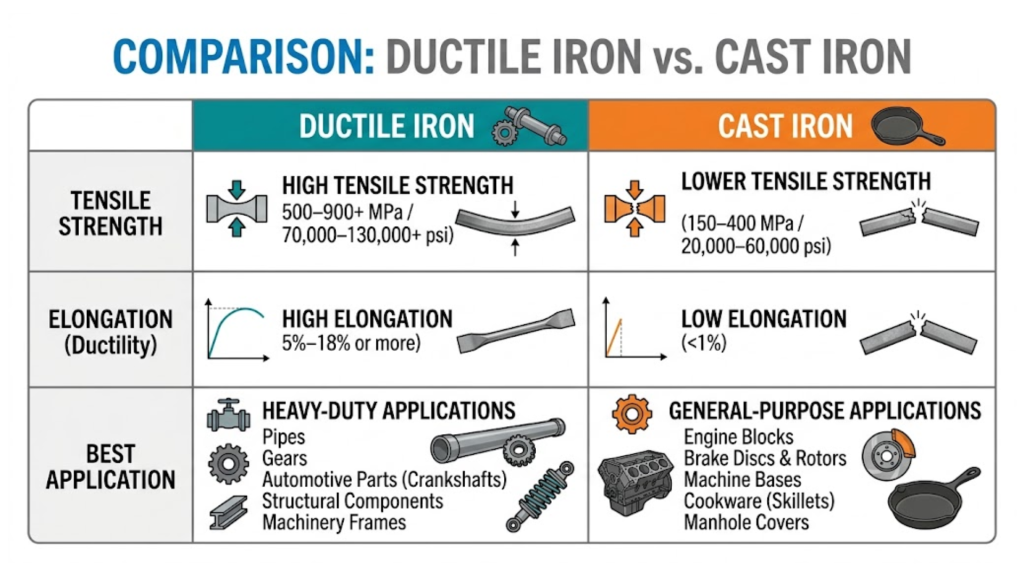
There is a difference between specifying “ductile iron” and specifying “Ductile Iron Grade 500/7 to ISO 1083.”
The grade tells you the tensile strength and elongation properties of the iron. For D400 road applications in the UAE, Ductile Iron Gr 500/7 to ISO 1083 is the correct specification. It has a minimum tensile strength of 500 MPa and a minimum elongation of 7%, which means it bends slightly under stress before it breaks — making it significantly more resistant to dynamic loads like heavy traffic than lower-grade materials.
Cast Iron is a different material entirely. It is stronger under compression but more brittle under impact, which makes it well-suited for lower load class applications (B125, C250) and less appropriate for high-speed traffic environments. Both materials have their place — the key is knowing which one you are specifying and why.
If your specification just says “manhole cover” without stating the material or grade, you are leaving the supplier to make that decision for you. That is not a position you want to be in when the inspector arrives.
Step 4 — Confirm the Coating for UAE Climate Conditions
The UAE is not a mild climate. Coastal areas like Ajman, Ras Al Khaimah, and Khorfakkan have high atmospheric salinity — salt in the air and salt in the soil. Inland areas have extreme heat and UV exposure. All of it accelerates corrosion in unprotected iron.
An uncoated cast iron cover in a coastal UAE environment will start to show surface corrosion within two to three years. Within five years it can have structural corrosion that affects the frame seal and creates a rocking problem.
The solution is straightforward. For any project in a coastal or high-humidity zone, your specification should require either:
Bitumen coating — a hot-applied black coating that forms a chemical bond with the iron surface. Cost-effective and highly durable. Standard practice in the industry.
Epoxy coating — a two-part polymer coating that offers superior resistance to chemical and salt attack. Typically specified for projects near the sea or in industrial environments with chemical exposure.
At Awwal Building Materials, epoxy and bitumen coating options are available on request for our full product range. If your project is in Ajman or along the UAE coast, we will always recommend confirming the coating spec before the order is placed.
A Simple Checklist Before You Sign Off
Before any manhole cover specification leaves your desk, run through these four points:
✅ Load class confirmed against actual traffic type Not the nearest round number — the actual expected traffic. If trucks will use the road, it is D400 minimum.
✅ EN 124 test certificate on file Not a brochure claim. The actual certificate, from an accredited testing body, for the specific product and load class.
✅ Material grade specified “Ductile Iron Gr 500/7 to ISO 1083” for D400 road applications. Not just “ductile iron.” Not just “iron.”
✅ Coating spec confirmed for location Coastal or high-humidity site — epoxy or bitumen coating required. Inland with moderate conditions — confirm with your supplier.
Getting all four right costs nothing extra. Missing any one of them can cost significantly more than the entire procurement budget for covers on that project.
How Awwal Building Materials Can Help
We supply EN 124-certified Ductile Iron and Cast Iron manhole covers across all six load classes — from A15 pedestrian covers to F900 aircraft pavement solutions — with full compliance documentation ready for your submittal.
Our team will confirm the correct load class and coating specification for your specific project location, and we will have the documentation in your inbox within 24 hours of your enquiry.
📩 [email protected] 📞 +971 52 562 9998 🌐 awwalbm.com