
Nobody budgets for a manhole cover failure.
It is not a line item in any risk register. It does not come up in project kickoff meetings. It is not something a procurement manager thinks about when comparing supplier quotes and trying to bring the materials budget in under target.
Until it happens.
And when it happens on a live UAE project — on a government housing scheme in Sharjah, on a commercial development in Dubai, on a municipal road in Ajman — the cost is never just the cost of the cover. It is everything that comes with it.
This post breaks down what that actually looks like. Not in theory. In the real, practical terms of what a UAE contractor, consultant, or project manager faces when a cheap cover fails.
The Procurement Logic That Creates the Problem
The logic is understandable.
A procurement manager is working with a fixed materials budget. They need manhole covers. Supplier A quotes lower. Supplier B quotes higher. Both claim EN 124 compliance. Both deliver to site. The procurement manager takes the cheaper option and closes the budget line.
That saving looks real. It is in the spreadsheet. It is visible.
What is not visible is what the price difference actually represents.
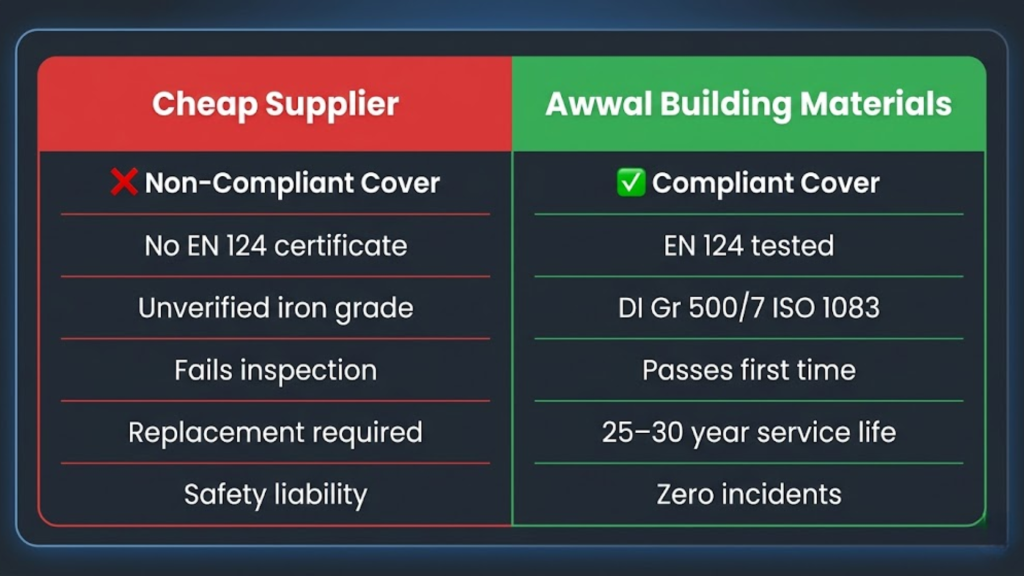
The cheaper supplier’s cover was produced without spectrometer-verified iron grade. The load test was conducted at the manufacturing facility without third-party accreditation. The EN 124 marking on the cover was applied without a corresponding test certificate from an independent body. The frame tolerance is wider than the standard requires.
None of this is visible on delivery. The covers look fine. They install without incident.
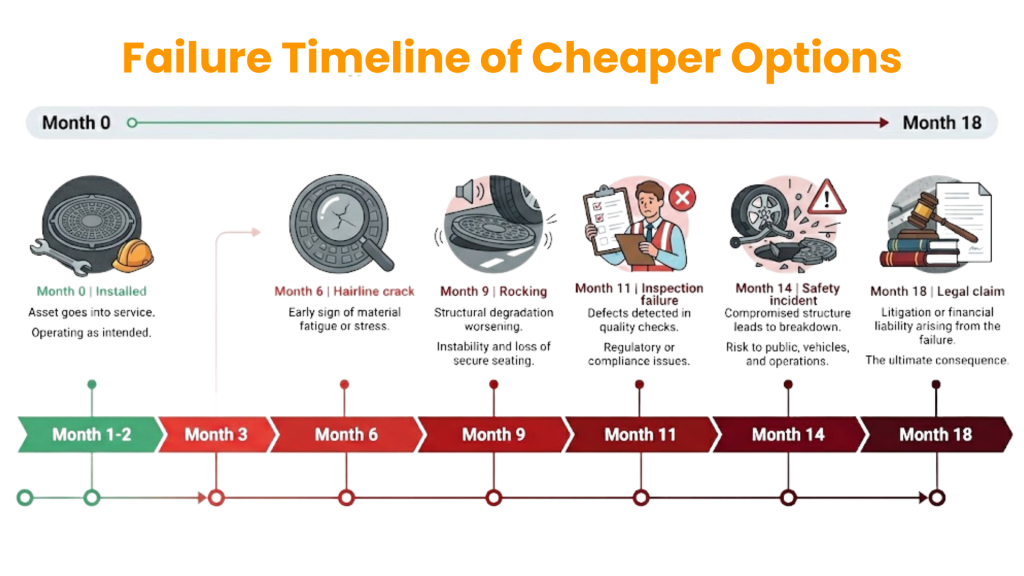
The problem starts six to eighteen months later.
Cost 1 — The Physical Failure
Ductile Iron Grade 500/7 to ISO 1083 has a minimum tensile strength of 500 MPa and a minimum elongation of 7%. These are not arbitrary numbers. They define exactly how much load the material can absorb before it yields, and how much it can flex before it fractures.
A cover produced from substandard iron — iron that has not been spectrometer-verified for composition, iron produced from uncontrolled scrap without proper treatment — will not meet these parameters. It may look identical to a compliant cover. It will not perform identically under repeated dynamic loading from UAE traffic.
The failure sequence is consistent across sites:
The cover develops a hairline crack — usually at the rim or across the surface. The crack is small enough to miss on a casual site walkthrough. Traffic continues to cross it. The crack propagates. The cover begins to rock in the frame. The rocking accelerates corrosion at the frame joint. Within weeks the cover is a confirmed defect.
On a residential estate road, this is a nuisance. On a main carriageway, it is a hazard — to vehicles, to pedestrians, and to the contractor whose name is on the project.
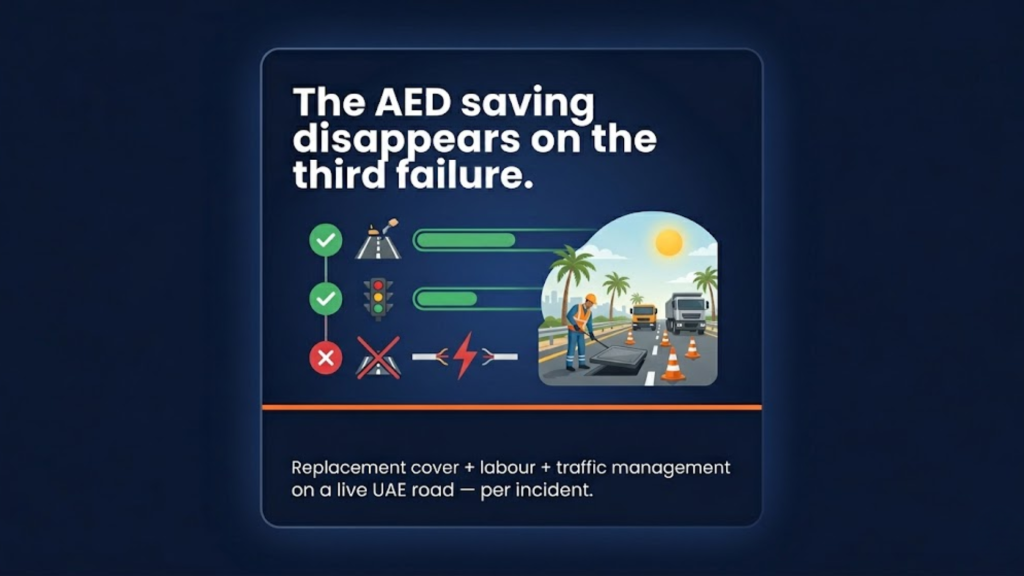
The direct cost: Replacement cover, labour, and traffic management on a live road — costs that multiply rapidly across a large project. The initial procurement saving disappears quickly once replacements begin.
Cost 2 — The Inspection Failure
UAE municipal authorities — Dubai Municipality, Sharjah Municipality, Ajman Municipality — inspect infrastructure projects before handover. That inspection includes verifying that installed components meet the specification stated in the tender documents.
If the tender specified D400 EN 124 compliant covers and the installed covers cannot produce a valid EN 124 test certificate, the project does not pass inspection.
This is not a grey area. There is no negotiation at the inspection stage. The covers must be replaced or the certificate must be produced. If it cannot be produced — because it does not exist — the covers must come out.
The cost of this is not the cost of new covers. The cost is the delay.
A UAE government project that misses its handover date because of a material non-compliance triggers a cascade of consequences. Liquidated damages clauses. Contractor penalty provisions. Sub-contractor payment holds. Client relationship damage.
In a market where government repeat business drives the majority of contractor revenue, the reputational cost of a delayed handover over a procurement saving is almost incalculable.
The direct cost: Liquidated damages on UAE government contracts can accumulate rapidly per week of delay. A multi-week delay caused by a non-compliant material — something that could have been avoided at specification stage — represents a catastrophic return on any procurement saving.
Cost 3 — The Safety Liability
A failed manhole cover on a UAE public road is not just a maintenance problem. It is a safety event.
A cover that has cracked or begun to rock under traffic creates a surface hazard. A vehicle wheel can drop into a partially collapsed cover. A pedestrian — particularly at night, or on an unlit section of estate road — can trip on a cover sitting proud of the finished surface due to frame distortion.
When this happens, the question of liability is not ambiguous. The cover was specified by the consultant. It was procured by the contractor. It was installed by the contractor’s team. The chain of responsibility is documented.
In the UAE, the regulatory framework for construction defects and public safety liability is unambiguous. Contractors carry liability for installed components that cause injury for the duration of the defects liability period — typically 12 months from handover, but often longer on government contracts. A safety incident involving a failed manhole cover within that period falls squarely within that liability.
The legal and insurance costs of a single injury claim on a UAE project — medical costs, legal representation, potential settlement, insurance premium impact — vastly exceed the savings of any procurement decision on manhole covers.
The direct cost: Impossible to quantify precisely — which is exactly the problem. It is an uncapped liability that sits quietly in the background of every project where non-compliant covers have been installed.
Cost 4 — The Reputation Risk
The UAE construction market is smaller than it looks.
There are perhaps 200 to 300 contractors, consultants, and project managers in the Sharjah and Ajman market who matter. They talk to each other. They share sub-contractor experiences. They know which contractors had inspection failures on which projects. They know which consultants approved which specifications.
A contractor who has a municipal inspection failure on a government housing project does not just lose that project’s repeat business. They lose the referral network that flows from a successful government delivery.
In the UAE, where procurement relationships are built over years and government repeat work is won on the basis of track record, a single high-profile defect is expensive in ways that never appear in a budget line.
This is the cost that no procurement model captures. It is the cost of being known, in a tight market, as the contractor who cuts corners on materials.
What the True Cost Comparison Looks Like
Every procurement decision has two price tags.
The first is the one on the quote. The second only appears later — in replacement costs, inspection delays, safety incidents, and damaged client relationships.
With a compliant supplier, the second price tag does not exist. The covers perform. The inspection passes. The project hands over on time. Nobody thinks about the manhole covers again for 25 to 30 years.
With a non-compliant supplier, the second price tag is always larger than the first — often significantly so. The gap between what was saved at procurement and what was lost in consequences is never close.
What Compliant Procurement Actually Looks Like
Specifying correctly is not complicated. It requires asking the right questions before the order is placed — not after the covers are installed.
Before approving any manhole cover supplier for a UAE project, confirm:
EN 124 test certificate — the actual certificate from an accredited third-party testing body, for the specific product and load class. Not a brochure claim. Not a self-declaration. The certificate.
ISO 9001:2015 certification — confirmation that the manufacturing facility operates under a quality management system that includes batch traceability, spectrometer verification of iron composition, and documented inspection at every production stage.
Material grade documentation — confirmation that the covers are produced from Ductile Iron Gr 500/7 to ISO 1083 for D400 applications, not from an unspecified or lower grade.
Dimensional compliance — confirmation that frame tolerances meet EN 124 requirements, ensuring the cover seats correctly in the frame and does not rock under dynamic load.
At Awwal Building Materials, every order is supplied with the full compliance pack — EN 124 test certificates, ISO 9001:2015 certification, material test reports, and dimensional drawings — ready for project submittal before a single cover is delivered to site.
Because the real cost of a wrong decision on manhole covers is never in the purchase order.
The Bottom Line
The cheapest manhole cover is the one that stays in the ground for 30 years without anyone ever thinking about it again.
The expensive manhole cover is the one that fails in month nine, triggers an inspection failure in month eleven, causes a safety incident in month fourteen, and is still costing the contractor money three years after project completion.
The difference between these two outcomes is not a number on a quote.
It is everything.
Get the full compliance documentation for your next UAE project:
📩 [email protected] 📞 +971 52 562 9998 🌐 awwalbm.com