
Drive along the coast road in Ajman, or through the older parts of Sharjah near the water, and you’ll see it eventually. A manhole cover with rust bleeding out from under the rim, orange streaks running into the surrounding asphalt. It looks old. It usually isn’t.
That cover is probably three to five years old. In an inland location, it would still look close to new.
The difference isn’t age. It’s air. And the fix is one line on a specification sheet that almost nobody adds.
Why coastal air does this
UAE coastal zones carry a level of atmospheric salinity that inland sites simply don’t deal with. Salt-laden humidity sits on exposed metal surfaces and accelerates oxidation in a way dry inland air doesn’t come close to. Add the temperature cycling that comes with UAE summers — metal expanding under 45°C heat, then contracting overnight — and you get a corrosion rate that inland specifications don’t account for.
Bare ductile iron performs well in most UAE applications. It’s a genuinely strong, EN 124 compliant material. But “performs well” assumes a baseline environment, and a site two kilometres from the Gulf isn’t that baseline.
The failure sequence is rarely dramatic. It starts at the frame seat, not the visible top surface — which is exactly why it goes unnoticed until the damage is well underway. Corrosion eats into the metal-to-metal contact between cover and frame. The tolerance that used to be tight starts to loosen. The cover begins to move under traffic. And a cover that moves is a cover that lets water into the bedding layer underneath it, which is a different problem entirely — one we’ve written about before, because it’s how road subsidence starts.
Why epoxy coating is the answer
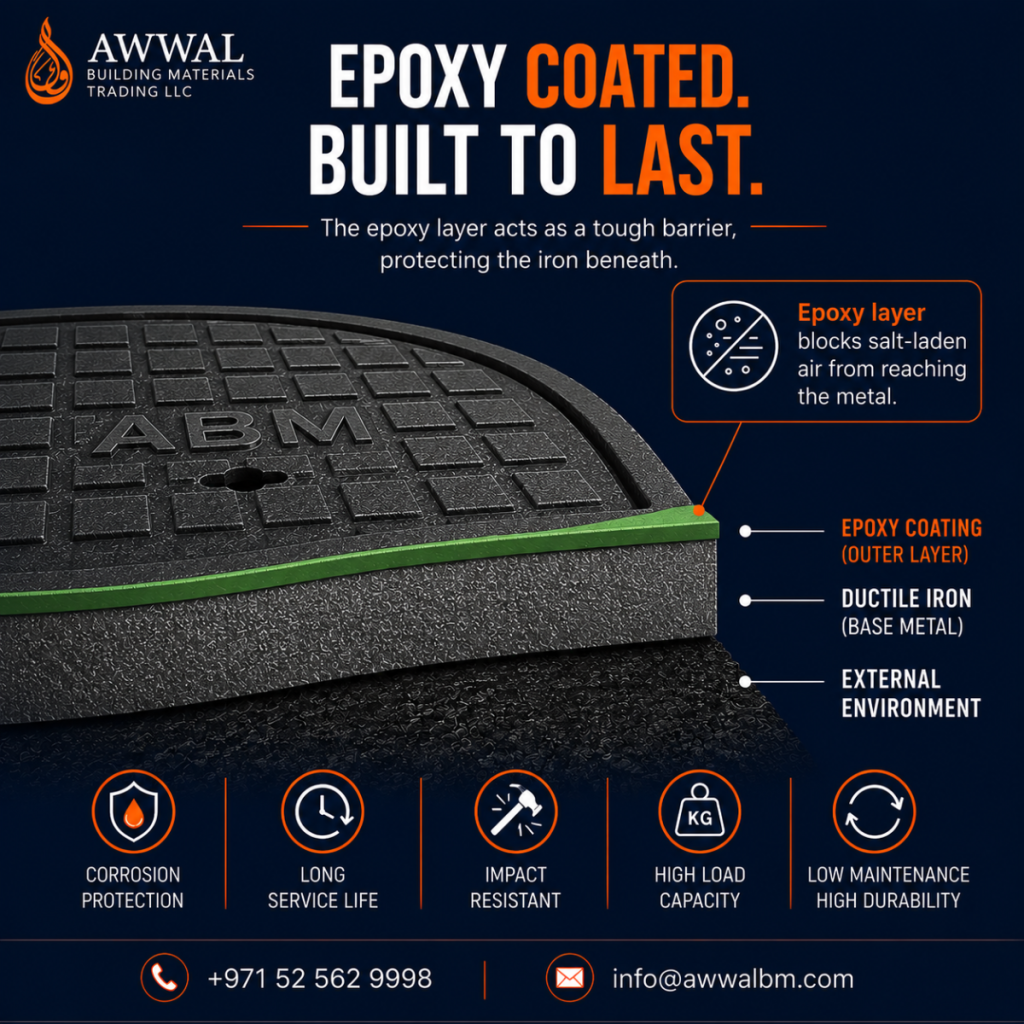
This is where epoxy coating does its actual job. It isn’t a cosmetic finish or an upsell — it’s a barrier layer applied directly to the ductile iron surface that stops salt-laden air from reaching the metal at all. No contact, no oxidation.
Epoxy holds up better than uncoated iron in every coastal test that matters: resistance to chloride exposure, resistance to humidity cycling, and resistance to the abrasion that comes from sand and grit blown across a UAE coastal road. It’s also the coating that performs best under the frame seat specifically — the exact point where corrosion starts and where a cover’s failure sequence actually begins.
The cost difference between an epoxy-coated cover and an uncoated one is marginal. What it buys is a barrier that holds for the cover’s full service life, in the one location where an uncoated cover has already shown a predictable three-to-five-year clock.
Compared to bitumen coating, which is a reasonable option for general, lower-exposure corrosion protection inland, epoxy is the correct call anywhere within a few kilometres of the coastline. It’s a harder, more chemically resistant finish, and it’s what’s specified as standard on UAE government coastal infrastructure projects for exactly that reason.
Why this keeps getting missed
The reason this keeps happening isn’t that epoxy coating is expensive or hard to source. It’s that nobody flags it. A specification written for a generic UAE project, without a location-specific review, defaults to standard uncoated covers because that’s what the template says. Nobody checks whether the project sits within a few kilometres of the coastline. The gap isn’t technical. It’s a missed question at the tender stage.
What to check before the next order
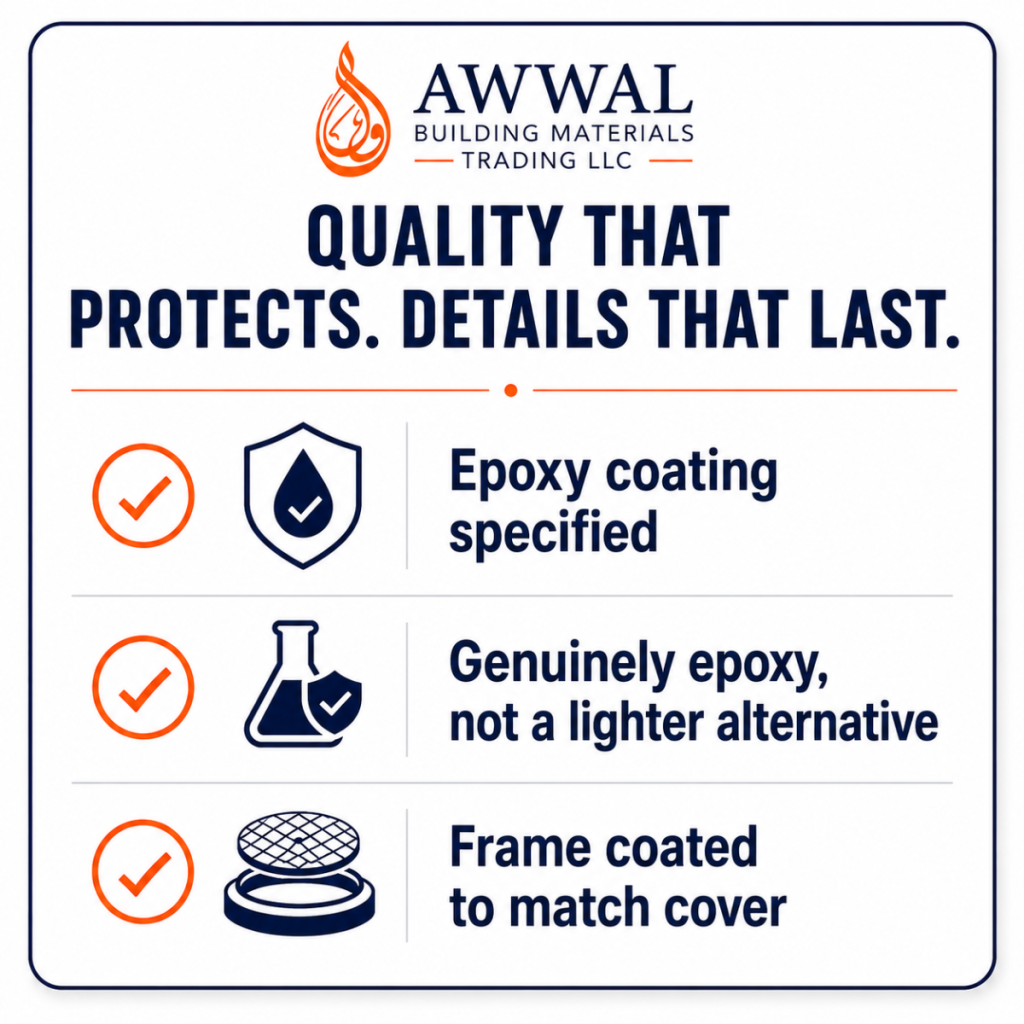
If a project is anywhere near Ajman’s coast, Sharjah’s waterfront areas, or RAK’s coastal roads, three things are worth confirming before covers go on order:
Whether the specification calls for epoxy-coated product, and whether anyone actually checked the site’s proximity to salt air exposure when that decision was made.
Whether the coating is genuinely epoxy rather than a lighter-duty alternative marketed under a similar name — the two are not interchangeable in coastal exposure.
Whether the frame carries the same epoxy protection as the cover. A coated cover in an uncoated frame still corrodes at the contact point — the weak link just moves to the joint.
None of this adds meaningful cost or time to a project. It adds one conversation at the specification stage, before the order goes in rather than after the rust shows up.
The bottom line
A cover installed today in a coastal zone without epoxy coating isn’t a failure yet. It’s a three-to-five-year clock. Whether that clock matters to a project depends entirely on who’s asking the question before the order is placed.
At Awwal Building Materials, epoxy-coated Ductile Iron is available across the full range for coastal UAE applications, with the coating specification confirmed and documented before delivery.
Specifying for a coastal UAE project? Get epoxy coating confirmed before you order.
📩 [email protected]
📞 +971 52 562 9998
🌐 awwalbm.com