
Two covers arrive on a pallet. Same size, same load class marking, same dark grey finish. One is grey cast iron, the other ductile iron.
Six years later they behave very differently, and by then it’s a road repair rather than a procurement conversation.
The difference is graphite shape
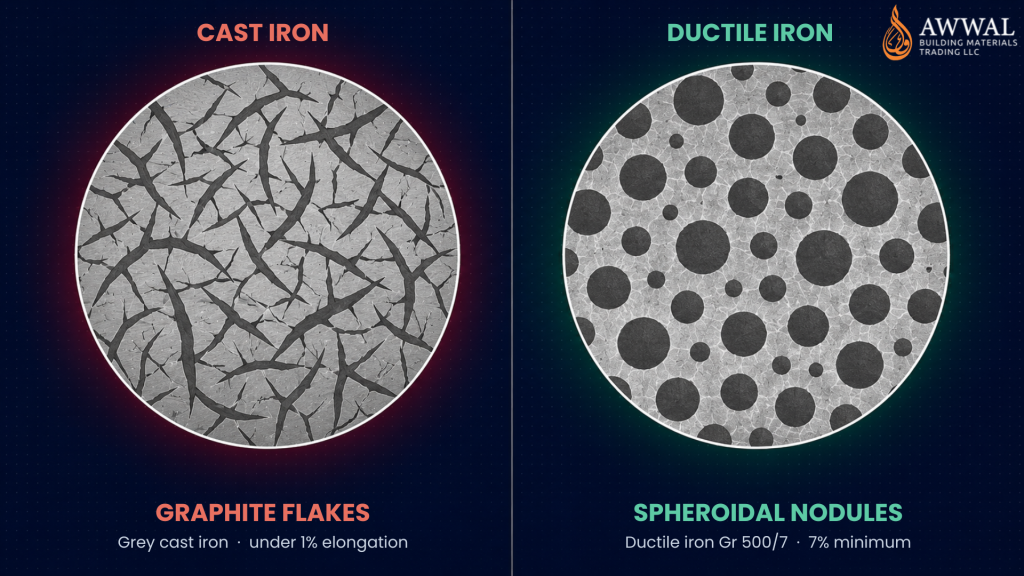
Both materials are iron with roughly the same carbon content, around 3 to 4 percent. What separates them is the form that carbon takes when the metal solidifies.
In grey cast iron, carbon forms as flakes. Thin, elongated, with sharp ends, distributed through the iron in a connected network. Those sharp tips are stress concentration points. Under load a crack starts at one and travels along the flake network, because the network is effectively a set of pre-built fault lines running through the material.
Ductile iron starts from the same melt. Magnesium is added before casting, which changes how the graphite grows. Instead of flakes, the carbon forms as separated spheres.
A sphere has no sharp tip for a crack to initiate from. The nodules sit isolated rather than connected, so the iron matrix between them stays continuous. Load travels through solid metal rather than around internal fault lines.
That’s the whole difference, and everything below follows from it.
What it means in numbers
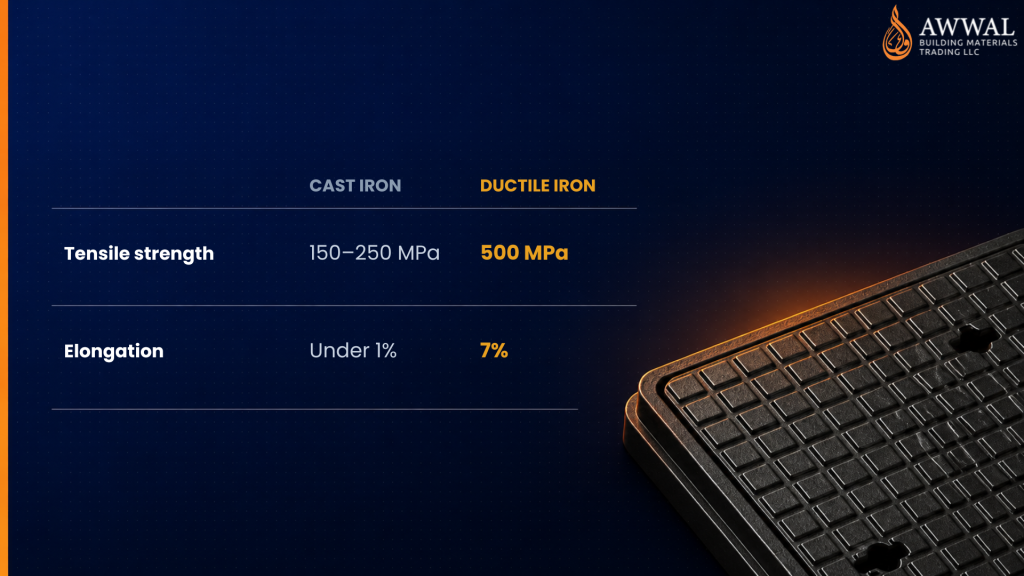
The property that captures it is elongation — how far the material stretches before it fractures.
Grey cast iron typically manages under 1 percent. Ductile Iron Grade 500/7 to ISO 1083 is specified at a minimum of 7 percent. That figure is the second half of the grade name: 500 MPa minimum tensile strength, 7 percent minimum elongation.
Tensile strength differs too. Grey cast iron commonly falls in the 150 to 250 MPa range depending on grade. Ductile iron at Gr 500/7 is specified at 500 MPa minimum, roughly double.
On a road, elongation is the number that matters most. It’s the difference between a cover that deforms visibly under an overload and one that fractures without warning. The first is something a site manager notices and reports. The second is an open hole in a carriageway.
Where each one belongs
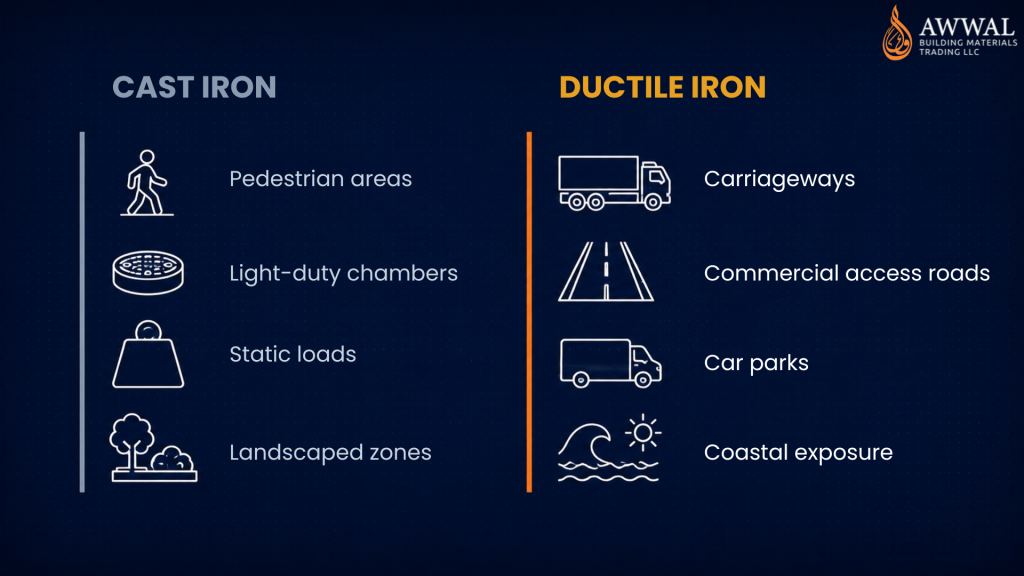
Cast iron isn’t a bad material. It’s been used in infrastructure for well over a century and it still has legitimate applications.
It performs adequately under static loads, in locations without repeated dynamic traffic, and where cost is the governing constraint. Pedestrian areas, light-duty chamber covers, and low-traffic zones are reasonable places for it. It’s widely available and generally cheaper.
Ductile iron becomes the correct specification wherever there’s dynamic traffic loading, vibration, or a requirement for higher load classes. Carriageways, commercial access roads, car parks handling delivery vehicles, and anywhere D400 is specified — these are ductile iron applications, and specifying grey cast iron in those locations is a compromise that shows up later rather than immediately.
The UAE-specific factors
Two local conditions widen the gap between the materials beyond what a general comparison would suggest.
Thermal cycling. Exposed road surfaces here run far above air temperature through summer, then drop sharply overnight. Metal expands and contracts against a frame doing the same thing. Ductile iron’s elongation capacity lets it absorb that movement elastically. More brittle material has less margin, and repeated cycles accumulate stress in a material that has fault lines built into its structure.
Coastal atmospheric corrosion. Both materials corrode in salt-laden air. The practical difference is that ductile iron takes an epoxy coating well and holds it, which for coastal Ajman, Sharjah and RAK projects is the difference between a cover that lasts and one that starts losing structural integrity at the frame seat within a few years.
Both can carry an EN 124 marking
This is the part that catches people out.
EN 124 is a performance standard. It defines load classes and test methods. It does not mandate a material. A cast iron cover that passes the D400 test carries the same marking as a ductile iron cover that passes it.
Passing the test at manufacture and performing over 25 years under UAE traffic and thermal conditions are different things. The marking confirms the first. It doesn’t guarantee the second.
Which is why the material grade should be a separate line in the specification, not something assumed from the load class. Ask for the material test report alongside the EN 124 certificate. The report states grade and composition for the batch, and it’s the document that tells you what you actually bought.
The practical summary
If the location has trucks, vibration, thermal exposure, or a D400 requirement, specify ductile iron and name the grade — Gr 500/7 to ISO 1083.
If it’s a pedestrian zone or a light-duty chamber and budget is genuinely the constraint, cast iron is defensible.
What isn’t defensible is not knowing which one arrived, because both look identical on the pallet and neither declares itself until it’s under load.
At Awwal Building Materials, every order ships with the material test report alongside the EN 124 certificate, so the grade is documented before delivery rather than assumed after it.
Specifying for a UAE project and not sure which material the application needs? Send us the details and we’ll confirm within 24 hours.
📩 [email protected]
📞 +971 52 562 9998
🌐 awwalbm.com