
Rain in the UAE doesn’t arrive gently. It comes in short, heavy bursts, and a road that drains fine on a normal day can hold water within minutes. What happens next depends on a part most people only notice when it fails: the grating at the kerb.
A channel grating has one job. It takes surface water off the road and passes it into the drainage below. It also has to carry a wheel while doing it. This guide covers where gratings go, how to choose the class, and what decides whether one actually drains.
A grating is not an access cover
The two get ordered together, but they solve different problems.
An access cover seals a chamber and lets someone get in. A channel grating does the opposite. It stays open on purpose, so water can get down. The slots that let water in are also the reason a grating has to be specified with more care than a cover. It has to stay strong with part of its surface removed.
Where gratings go on a UAE project
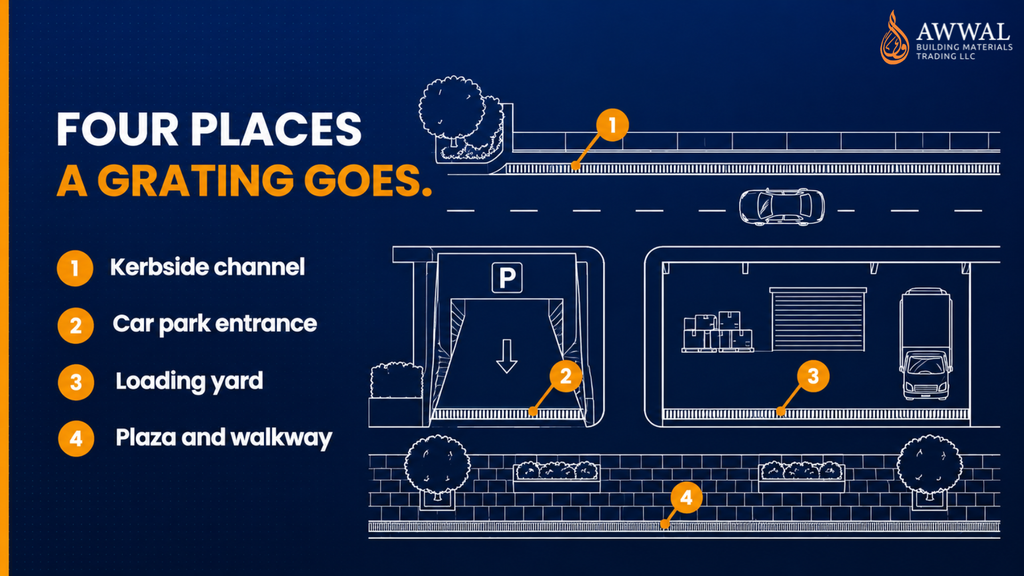
- Kerbside channels along carriageways, where surface water runs to the edge.
- Car park and ramp entrances, where runoff gathers at the threshold.
- Loading yards and service areas, where wheels are heavy and surfaces are wet from washing as well as rain.
- Linear drains in plazas and walkways, usually the lightest-duty location.
The usual mistake is to treat all of these as one location. The wheel that reaches a kerbside grating is not the wheel that reaches a plaza drain.
Sizes and classes in the ABM range
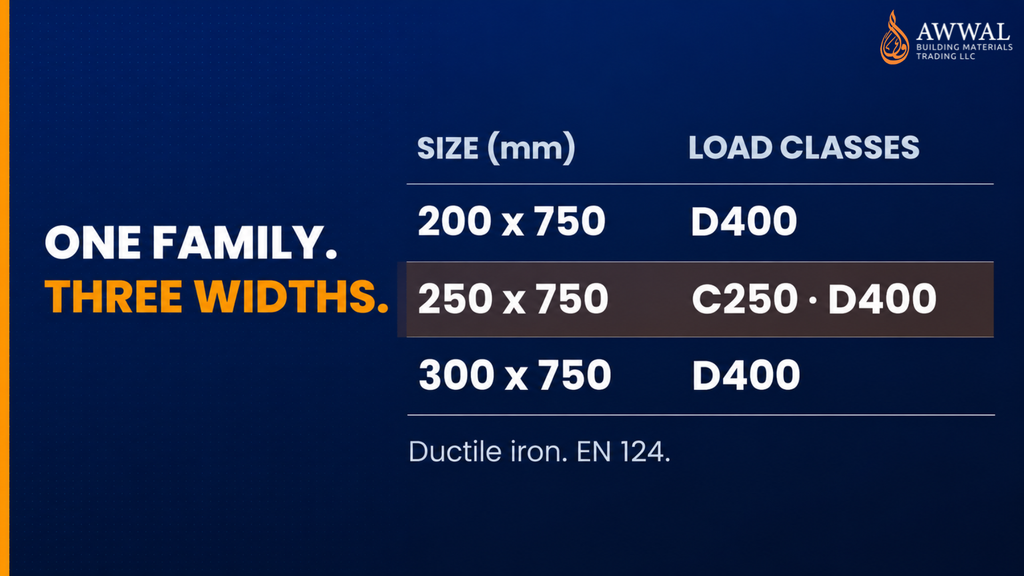
| Size (mm) | Load classes |
|---|---|
| 200 × 750 | D400 |
| 250 × 750 | C250, D400 |
| 300 × 750 | D400 |
All are ductile iron, EN 124 certified, from an ISO 9001:2015 plant. For the full meaning of each class, see the load class guide.
Choosing the class: C250 or D400
Under EN 124, C250 describes the kerbside channel zone, a short distance into the carriageway. D400 covers the carriageway itself. The choice sounds simple, but the dividing line is not where the kerb is drawn on the plan. It is where a wheel can reach.
Specify C250 where the grating sits in the channel and vehicles genuinely stay out of it.
Specify D400 where trucks mount the kerb, where the grating sits at a carriageway edge or a junction, or where the area is a service yard. If the construction traffic will be heavier than the finished use, specify to that or protect the grating until the heavy work is finished.
When it’s close, go up one class. The cost is small at order stage. A cracked grating on a live road is not.
Four things that decide whether it drains
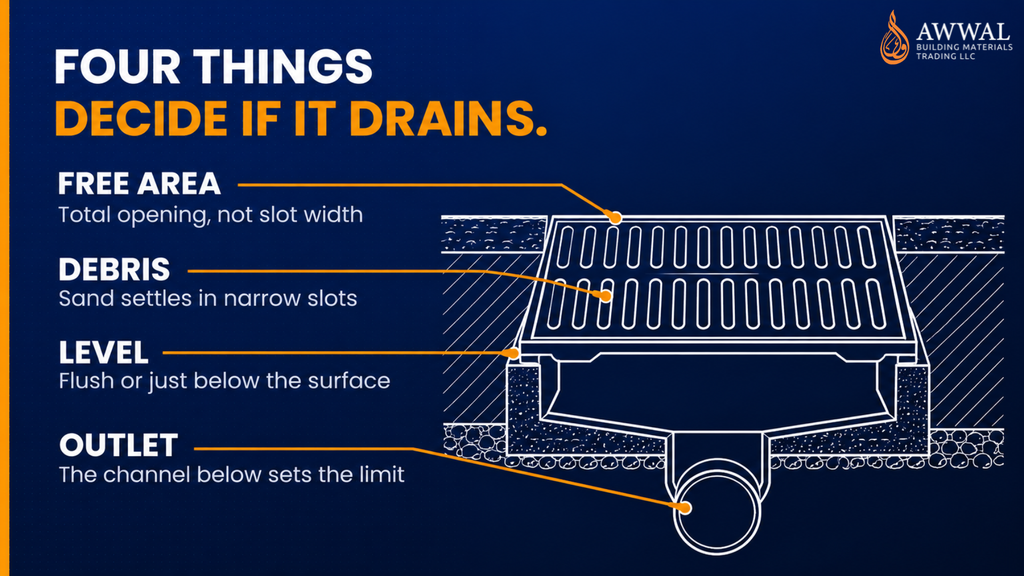
The grating is one part of a system. It can only pass what the channel and outlet below can carry. A well-chosen grating over an undersized channel still backs up.
Free area. This is the total opening in the grating surface, not how wide any single slot looks. Two gratings of the same size and class can pass different volumes of water. Ask for the free area figure on the supplier’s drawing, and compare it with the design flow from the drainage engineer.
Debris. UAE sites carry sand and construction dust that settle in slots, especially narrow ones. A grating that drains well on handover day can lose capacity within a season. Slot width is a trade-off between flow and debris, so match it to how the site will be maintained.
Level and fall. Water follows the surface to the grating, so the grating has to sit at the right height. Set it flush or marginally below the finished surface so water reaches it. Never leave it proud, because a proud edge diverts flow and gets hit by every wheel.
Installation matters as much as the product
A grating that rocks fails the same way a cover does. The frame has to be level and bedded properly, and the bedding has to survive the water it is there to handle. Water running past a poorly seated frame washes out the support beneath it, which is the same sequence described in our road subsidence guide.
Before the road closes over it, press the grating at the corners and watch for movement.
Check it before the rain does
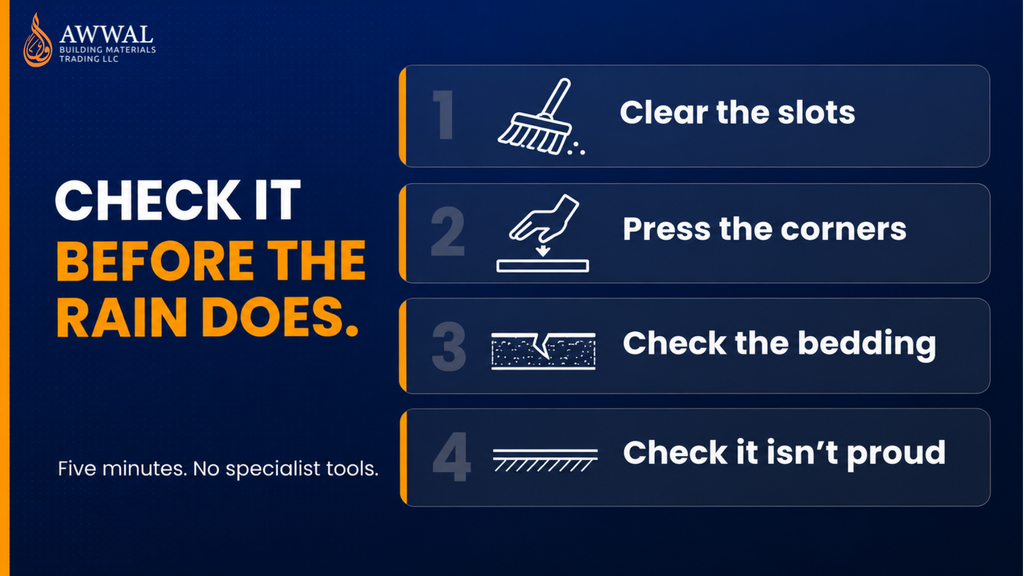
A short check, done before the wet season:
- Clear the slots of sand and debris.
- Press the corners and check for movement.
- Look for cracked or eroded bedding where the frame meets the road.
- Confirm the grating is not sitting proud of the surface.
None of it needs specialist equipment. All of it is cheaper than repairing the road afterwards.
At Awwal Building Materials, channel gratings come in C250 and D400, with the dimensional drawing supplied before delivery so the frame and size can be confirmed before anything is cast into the slab.
Planning drainage for a UAE road? Send us the location and the traffic type, including any construction traffic. We’ll confirm the right grating and class within 24 hours.
📩 [email protected]
📞 +971 52 562 9998
🌐 awwalbm.com